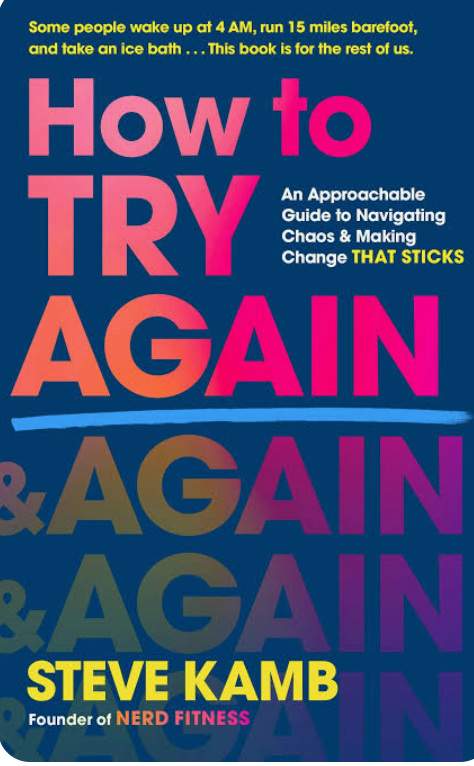
Steve Kamb wrote his book How to Try Again for those who fail and want to learn how to get back up and attempt new (or old) endeavors. His encouragements begins by reminding us that we’re never back at square one. Too often, we get discouraged when we fail because we have to start all over again. But Kamb points out that when we start again, “We get to bring all of our past knowledge with us, because we’ve already taken so many difficult steps (24). Instead of rushing into another attempt, Kamb tells us to make a PACT with ourselves, an acronym to help us build lasting change: pause, accept, change, and try.
Sometimes getting back up and getting back into something too quickly actually makes things worse. So instead of rushing to make changes, Kamb advocates that we Pause. He tells us to stop and just tread water. Don’t make things, but pause and evaluate where you’re currently at. Your current season might just not be conducive for training for marathon. That’s ok.
After pausing, Kamb tell us Accept for current situation. We don’t have to like it but we do have to accept it. It just is. We need to stop trying to get back to “normal.” We need to resist the thinking that we’ll get around to something “when things slow down.” They usually don’t. But things never get back to normal. So accept things as they are. Once we accept reality, we can Change. But change happens through running experiments, rather than setting unrealistic goals. An experiment is necessarily time-bound with a time to evaluate: How did it go? Is it actually working? Am I moving toward the life I want? If not, we can abandon the experiment and move on to something else. Once we determine that we are going to change, we just Try. Trying means getting over the hurdle of perfection. We just need to start ugly. Every time we start something new, we’re going to suck at it. So might as well suck.I
The kind of permanent change we need is not “all in” resolutions but steady consistent changes, We need to find something “we can follow pretty consistently, most of the time, for a long time” (129). The long term change happens when we’re inconsistently consistent rather than going “balls to the wall” for two weeks!
Kamb has written a helpful book for producing changes that stick in a sometimes (overly) conversational style. 4.5 stars out of 5.

