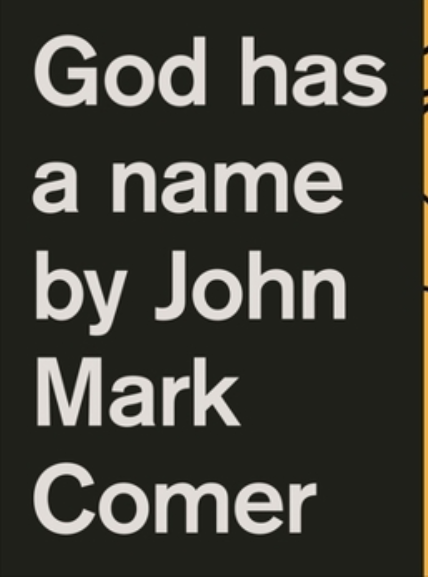
Let’s start with a quote from an author, but not from John Mark Comer, the author of God Has a Name: “What comes into our minds when we think about God is the most important thing about us.” That’s a quote from theologian A. W. Tozer in the 1960s. Fast-forward to 2017 and Comer is trying to take Tozer’s sentiment and apply it to this time and place. He’s trying to help people understand who God is and how that affects their lives (20-21).
Comer argues that one of the best places to come to a clearer and deeper understanding of God is by studying God’s revelation of his own name in Exodus 34:4-7: “It’s one of the few places in the entire Bible where god describes himself” (32). Comer then breaks down the passage phrase-by-phrase, with each phrase being its own chapter.
Comer’s book is a complicated read, not because the writing is inaccessible or dense. His writing is actually extremely conversational. Instead, the book is complicated because there are many concerning things (especially about the nature of God) mixed in with so much good.
Comer excels at challenging the beliefs and assumptions of secular Americans who live in the Pacific Northwest. Comer was a long-time pastor in Portland after all! I liken him to a Northwestern Tim Keller. The late pastor Keller brilliantly applied the truths of Christianity to the underlying belief structures of New York City city-dwellers. In a very Keller-esque passage, Comer writes, “Who God is has profound implications for who we are. Here’s the problem: we usually end up with a God who looks an awful lot like us” (25). Later on he explains, “Here’s how to know if you’ve created God in your own image: he agrees with you on everything” (26). Comer, like Keller, has a knack for being able to bridge the biblical text to modern life in a compelling way.
Besides speaking about forming God in our own image, Comer helpfully makes the case for why people actually crave the wrath of God in chapter 4. He points out that God’s anger is settled opposition to evil “in all its forms” (quoting another theologian, 162). Therefore, God’s wrath is actually a good thing because he is not content to allow evil to win. Yet God’s anger is not like our anger (162-163). Whereas our anger is often motivated by hurt feelings or an inflated ego, God never allows sinful inclinations to taint his wrath.
While some Christians may have issues in how Comer formulates some of his theology, it’s important to remember that he upholds important theological truths. He affirms the exclusivity of the gospel (with really helpful illustrations) (107-108), the reality of God’s wrath (165-170), and God’s simplicity, the teaching that God is not composed of parts but is fully integrated within himself (although he doesn’t use that term) (194-195).
And yet, there are significant issues with the book.
There are a few times in the book where Comer has an opportunity for a “slam dunk” of clearly articulating important gospel truths because the structure of his chapter would have naturally led to a discussion of those truths. But unfortunately, he either doesn’t discuss those things or he downplays or denies those truths. For example, in his chapter on God’s wrath (chapter 4), Comer never explains how Jesus averts the wrath of God on our behalf through his death on the cross, the view of atonement known as penal substitutionary atonement. Not only does Comer not explain this viewpoint, he implicitly criticizes it by writing that “The New Testament writers never say the Father, ‘pours out his wrath on the Son'” (244). Comer understands the language of “pouring out wrath” on the Son to mean that the Father would have been angry with Son. But, in Comer’s view, the Father cannot be angry with the Son because the Son, is, well, the Son (244). Thus, Comer seems to deny penal substitutionary atonement (even though he does, in fact, state he believes in substitutionary atonement) (100).
If penal substitutionary atonement is not the core truth of Jesus’ death on the cross, what is, according to Comer? Earlier in the book, Comer advocates for the Christus Victor model of the atonement. He even goes so far to say that Jesus’ defeat of the evil spiritual powers is the “most ancient reading of the cross” (100). But Comer’s statement is just not true! Jesus’ sacrifice was built upon the foundation of the Old Testament sacrificial system. The OT sacrifices overwhelming concerned how sinners can approach a holy God, more so than the defeat of evil spiritual powers. The most ancient reading of the cross is more like the Day of Atonement in Leviticus 16 than Christus Victor.
Comer also seems to misunderstand what preachers mean when they say the Father “poured out his wrath” on the Christ on the cross. Preachers do not typically mean that the Father is displeased with the perfect, innocent Son of God. What they mean is that the the punishment for sin (hence penal substitutionary atonement) is put on Christ on the cross so that we would not have to be punished for our sins. Comer seems to be confusing the Father’s judicial acts with the Father’s disposition. The Father isn’t angry with the Son. Preachers use the imagery of Father’s wrath being “poured out” because it is a common image of Yahweh’s judgment against sin (2 Chronicles 12:7; 34:21, 25; Isa. 42:25). The New Testament also speaks of us being saved from the wrath of God through the death of Jesus: “We have now been justified by his blood, much more shall we be saved by him from the wrath of God” (Romans 5:9).
The Christus Victor model is true (Colossians 2:13-15). But my issue with Comer is that he elevates a more “secondary” view of the atonement to pride of place while ignoring huge swaths of texts on Jesus’ sacrifice for our sins. The New Testament spends way more time on Jesus’ cross as the solution to human sin and God’s justice than on the cross as the defeat of the evil spiritual powers. His focus on secondary, or niche, theological views comes out in his discussion of the “divine council” (79-90). Of course the spiritual realm is real. But Comer makes a big deal about all these other “gods” being around in the spiritual realm. His warning that we must be careful in “plugging into” the spiritual world is definitely needed. But there is a lot of debate in the church over the “divine council” view and many of the texts he cites could be read in different ways.
The most concerning aspect of the book is Comer’s view on the nature of God. For a book which is all about how we think about God and who he is, Comer makes some statements that could be read as borderline unorthodox. For instance, Comer seems to be deny God’s immutability, of his inability to change:
“[God] regretted his decision to judge Israel so harshly, and so he changed his approach. All of this leads to a vision of a God who responds. Who is open to our ideas, dynamic—involved in our lives, but not ‘in control’ in the automated, what’s-going-to-happen-is-going-to-happen-with-or-without-me kind of way” (62).
“Yahweh isn’t the ‘unmoved mover’ of Aristotle; he’s the relational dynamic God of Abraham, Isaac, and Jacob. The God who responds. Who can be moved, influenced, who can change his mind at a moment’s notice…He would be less of a God if he couldn’t change his intentions when he wants to, or be open to new ideas from intelligent, creative beings he’s in relationship with” (64).
The problem with God being able to change is that it would make him, well, less God. Classical orthodox theology in the history of the church has asserted God immutability. God cannot change, grow, or get better. If God is “open to new ideas” from us, it seems to imply some deficiency in God’s understanding. But God literally knows everything! He cannot get smarter! If God could change, he wouldn’t be God. Furthermore, if God can change his mind at a moment’s notice, maybe he’ll change his mind to save us? Or keep us saved? A God who can change is an unreliable God, not a strong tower we can run to and be safe.
Comer’s view on God’s nature also bleed into his views of God’s sovereignty. He writes quite plainly, “The future is not set in stone” (65). Comer wants to preserve the freedom of our choices, and the freedom of other spiritual being’s choices (109-110). He does so in order to present a theodicy, a defense of God in the face of evil. Comer’s asserts that we should not end up attributing evil in the world that comes through our, or Satan’s choices, to God (111). Obviously, we should never blame God for evil. I do believe that all evil in the world comes from beings other than God. But we’re still left with the lingering question: Why does God allow it?
Comer merely kicks the can down the road a little. Scripture gives us some hints as to why God allows evil (2 Peter 3:9) but never a full blown theodicy. Maybe we just need to admit that God allows evil for some unknowable reason? Now, Comer does believe in the sovereignty of God. He writes, “It’s not that God’s will is weak—on an even playing field with all the other God. As if we, God, and Satan are equal players in a game for the world” (110). But then he wants to make a case of a fairly large amount of freedom for creatures in this world, “It’s that in the universe God has chosen to actualize, love is the highest value, and love demands a choice, and a choice demands freedom” (110). I guess my question is this: How far does God’s “limitation” of his own will extend in this world he has chosen to actualize? Does he give Satan enough freedom to thwart his plan? Can Jesus be defeated if the future is open and undetermined?
But, at the end of the day, if you are an orthodox Christian, you’ve read Revelation. You know God wins in the end, so you know that his will overrides all other wills at some point. Following Comer’s logic, even if God wins in the end, it could provoke questions like, “Is it fair for God to take away our ability of choose at the very end? Would that destroy love?” Instead, Scripture paints a picture of a God who is completely sovereign over all things, knowing the end from the beginning (Isaiah 46:10). And yet, from our finite creaturely experience, we make choices and stumble through this life. How these two things cohere is a bit of a mystery, but limiting God’s sovereignty is not the right way to make sense of these things.
Conclusion
The worst thing you can do is read only books that affirm what you already believe. I have found that instead of making me doubt my beliefs, when I read “the other side,” being exposed to the best arguments of those who disagree with me helps me have a nuanced and refined view of things, even strengthening my beliefs. In other words, we should read books critically. We should actually think through them. So, for that reason, I am glad that I read God has a Name by John Mark Comer. It has some fantastic moments and insights, things which I will bring into my own teaching and preaching. But it also has some concerning missteps. Honestly, if Comer made some slight tweaks to books, interpreting Scripture in light of the history of the church being one of them, the book would be a slam dunk.

